


A federal white collar crime investigation often runs quietly before anyone is charged, while agents gather records. If agents contact you, a knowingly false answer on a point that matters is its own federal crime under 18 U.S.C. § 1001, with up to 5 years, even without an oath.
This guide is for business owners, managers, bookkeepers and other professionals in Greensboro and the Triad. Federal cases from Guilford County belong to the Middle District of North Carolina.
A lawyer who steps in now can talk to the prosecutor and protect your rights, depending on the facts of your case. Before you answer an agent, talk with a federal criminal defense lawyer in Greensboro.
Contacted by agents, or worried you might be? Call (336) 379-0539 and ask for Jason Aycoth’s team before you answer any questions.
What Triggers A Federal White Collar Investigation
Most federal white collar investigations start with information someone hands to an agency. It can be a tip from an employee or customer, an audit, or facts found in another investigation.
IRS Criminal Investigation says a case can start inside the IRS when an auditor, a collection officer or an analyst detects possible fraud.
Leads also come from the public and from other law enforcement agencies. Agents then gather records before anyone is told.
Who Investigates White Collar Crime?
The FBI and IRS Criminal Investigation handle many federal financial cases. The FBI white collar crime program covers health care, mortgage, corporate, securities and financial institution fraud, plus money laundering.
IRS Criminal Investigation works tax and financial crimes. Federal prosecutors in the U.S. Attorney’s office bring the case in court, and for Guilford County that is the Middle District of North Carolina.
State charges can run on a separate track.
Embezzlement under G.S. 14-90 is a North Carolina felony. If money went missing at work, read whether embezzlement is criminal or civil in this state.
To see where these cases can lead, read about the white collar charges filed in Greensboro and how each one is defended.
How Investigations Develop Before Anyone Knows About Them
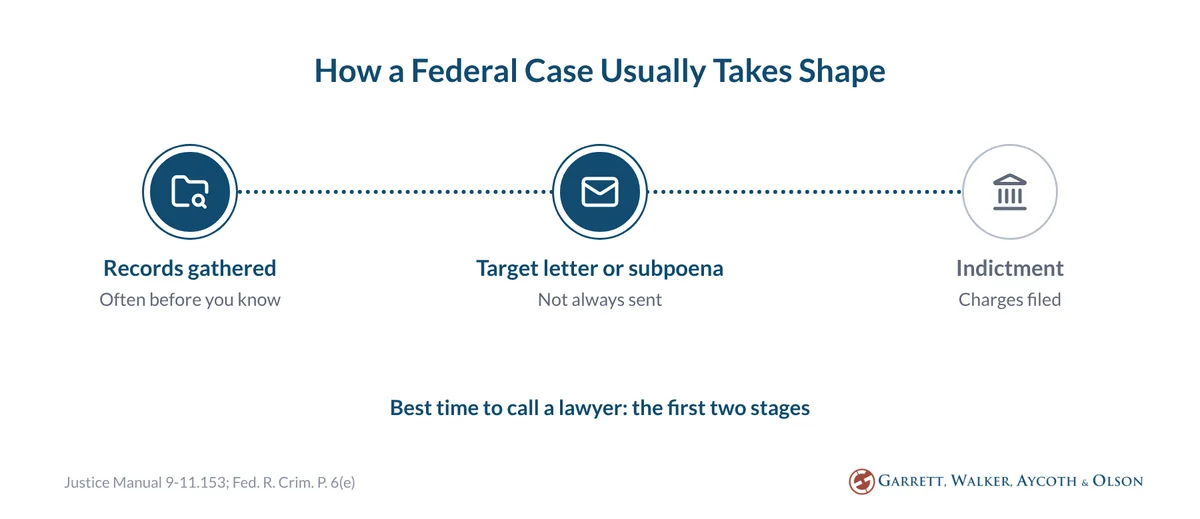
A federal probe is the quiet stage when agents and prosecutors gather records and interview people before deciding whether to charge anyone. The person being investigated often learns about it late.
IRS Criminal Investigation lists its tools: interviews of third party witnesses, surveillance, search warrants, subpoenas for bank records and reviews of financial data. Your bank, your accountant or a former employee may be asked for records long before you are.
Grand jury work is secret by design. Under Federal Rule of Criminal Procedure 6(e), grand jurors, government lawyers, interpreters and court reporters must keep grand jury matters secret.
Time passing does not make an old matter safe. For most federal crimes, 18 U.S.C. § 3282 requires the indictment within five years of the offense, unless another law sets a different period.
Some white collar crimes get longer. Bank fraud, bank embezzlement and false statements to a bank get 10 years under 18 U.S.C. § 3293, and tax evasion and most tax fraud get 6 years under 26 U.S.C. § 6531.
Target, Subject or Witness: What Your Status Means
The Justice Department uses two labels for people in a grand jury investigation: target and subject. Your label shapes what your lawyer does next.
Under Justice Manual 9-11.151, a target is a person the prosecutor or grand jury has “substantial evidence linking him or her to the commission of a crime.” The prosecutor also sees that person as a likely defendant.
A subject is a person “whose conduct is within the scope of the grand jury’s investigation.” The definition sets no probable cause test, so being a subject does not mean you are clear.
Anyone else called to give information is usually treated as a witness.
Status can change as evidence comes in. A witness today can become a subject later, so your lawyer can ask the prosecutor where you stand before you say anything.
Talk to a defense lawyer before you talk to anyone else
What you say and sign in the first days often decides what is possible later. The earlier we see your paperwork, the more options you usually have.
Call (336) 379-0539Free consultation with a Greensboro attorneyTarget Letters, Grand Jury Subpoenas and Agent Visits
Each of these is a different signal, and each one calls for a different first move.
| What You Received | What It Usually Signals | Your First Move |
|---|---|---|
| Target Letter | The prosecutor sees you as a likely defendant (JM 9-11.151, 9-11.153) | Call a lawyer before any reply |
| Grand Jury Subpoena With an Advice of Rights Form | DOJ attaches that form for targets and subjects (JM 9-11.151) | Have a lawyer review it well before the date |
| Agents at Your Home or Office | They want a statement now | Get their names and cards; tell them your lawyer will call |
What a Target Letter Means
A target letter tells you the prosecutor sees you as a likely defendant. Under JM 9-11.153, prosecutors are “encouraged” to give notice in appropriate cases, a reasonable time before seeking an indictment.
The letter is not required. DOJ policy says notice is not appropriate in routine clear cases or when it could lead to flight or destroyed evidence, so no letter does not mean you are safe.
If You Get a Grand Jury Subpoena
DOJ policy attaches an Advice of Rights form to grand jury subpoenas served on targets and subjects. The form says you may refuse to answer any question if a truthful answer would tend to incriminate you.
It also warns that anything you do say may be used against you. If you have a lawyer, the grand jury will give you a reasonable chance to step outside and consult with counsel.
A target and lawyer can sign a letter saying the target will assert the Fifth Amendment. Under JM 9-11.154, the target ordinarily should then be excused from testifying.
Rule 6(e) does not itself swear witnesses to secrecy. Other laws and court orders can limit what some people, such as bank employees, may disclose, and discussing your testimony with others in the case can create new problems.
Talk to your lawyer before you tell anyone about a subpoena.
When FBI or IRS Agents Show Up
Agents who come to your home or office usually want a statement right then. Take their names and cards, and tell them your lawyer will call.
A knowingly and willfully false statement on a material point to them is a crime under 18 U.S.C. § 1001. The statute does not require you to be under oath.
“… whoever, in any matter within the jurisdiction of the … Government of the United States, knowingly and willfully … makes any materially false, fictitious, or fraudulent statement or representation … shall be fined under this title, imprisoned not more than 5 years …” 18 U.S.C. § 1001(a)(2)
Got a letter, a subpoena or a business card left at your door? Call (336) 379-0539 today, before the date on the paper or the agent’s follow-up call.
What Early Warning Signs Sometimes Look Like
Many people hear about an investigation secondhand before any letter arrives.
A coworker or business partner says agents called them. Your bank or accountant gets a request for your records, or an audit becomes unusually focused on one issue.
None of these is proof that you are a target. Each one is a reason to call a lawyer before agents contact you directly.
If the trouble started with an embezzlement accusation at work, a state charge may be filed as well.
Mistakes That Turn an Investigation Into a Bigger Case
The most damaging mistakes are new crimes created during the investigation itself. A new charge like that can be easier to prove than the original suspicion.
The first is a false answer to an agent. Stating a guess as if you were sure is risky, because a knowingly false statement on a material point can bring up to 5 years under 18 U.S.C. § 1001.
Deleting, changing or hiding records, emails or files to influence a federal investigation can bring up to 20 years under 18 U.S.C. § 1519. The law covers acts “in relation to or contemplation of” a federal matter, so an investigation you only expect counts too.
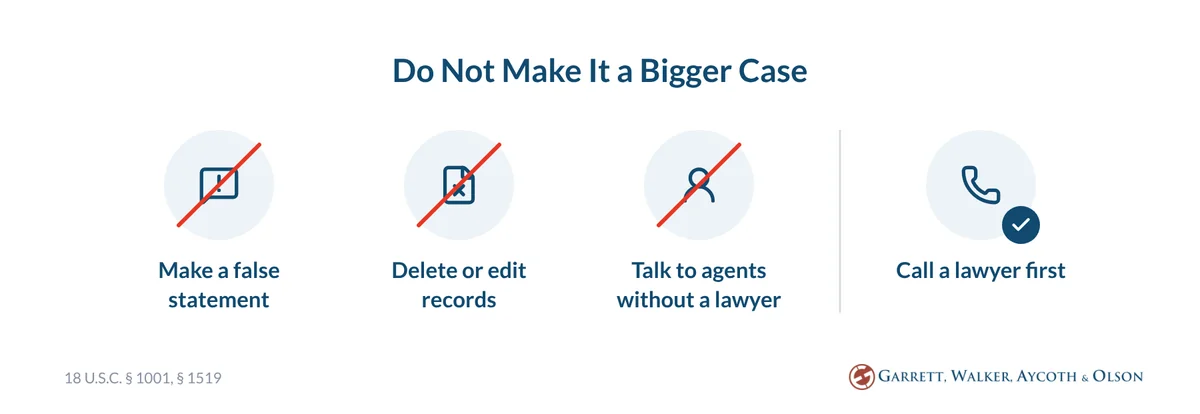
Another mistake is talking with coworkers about what to say. Even honest people can look like they are lining up a story, so let your lawyer handle those contacts.
If more than one person is involved, see how federal conspiracy charges are built. If the investigation turns into a case, defending a fraud charge in North Carolina starts with the records.
Why Acting Before Charges Are Filed Matters
Before an indictment, a lawyer can still talk with the prosecutor while the case is taking shape. Once the grand jury indicts, that early window is gone.
Depending on the facts of your case, a lawyer can review the subpoena or letter, ask about your status and help preserve the records you need. Your lawyer also decides with you whether to testify or assert the Fifth Amendment in a signed letter under JM 9-11.154.
Target status can end, too. Under JM 9-11.155, the U.S. Attorney has the discretion to tell a person they are no longer a target, so your lawyer can ask, though no such letter has to be sent.
Guilford County federal cases are heard in the Middle District of North Carolina, which holds court in Greensboro, Durham and Winston-Salem under 28 U.S.C. § 113(b). For what to expect in court, read how federal court in the Middle District works for Greensboro cases.
Our criminal defense attorneys in Greensboro handle state and federal cases.
Do not wait for an indictment. Call (336) 379-0539 to talk with our federal criminal defense team in Greensboro before you answer the government.
Frequently Asked Questions
How do I know if I am under federal investigation?
Often you do not know until a coworker is contacted, a subpoena arrives or agents call. Target letters are not required under JM 9-11.153, so silence does not prove you are clear. If you see a warning sign, call a lawyer first.
Does the FBI investigate financial crimes?
Yes. The FBI white collar program covers health care, mortgage, corporate, securities and financial institution fraud, plus money laundering. IRS Criminal Investigation handles tax and financial crimes. Either agency may contact your bank, accountant or coworkers before it contacts you.
What is a target letter?
A target letter tells you the prosecutor sees you as a likely defendant, a person linked to a crime by substantial evidence (JM 9-11.151). DOJ encourages sending one in appropriate cases, but it is not required. If you get one, call a lawyer before you reply.
Is it a crime to lie to the FBI if I am not under oath?
Yes. Under 18 U.S.C. § 1001, a knowingly and willfully false statement about a material fact in a federal matter is a crime with up to 5 years in prison. The statute does not require an oath. If you are unsure of an answer, tell the agent your lawyer will respond.
Do I have to talk to FBI or IRS agents who come to my house?
You can tell them your lawyer will call instead of answering on the spot. Take their names and cards, then call (336) 379-0539 before you say more. Anything you say can be used later, and a false statement can become its own federal charge.
Can I tell people about my grand jury subpoena?
Witnesses are not on the Rule 6(e) list of people sworn to secrecy. That does not make sharing safe. Other laws and court orders can bind some people, such as bank employees, and comparing notes with others in the case can create new problems. Ask your lawyer before you tell anyone.
How long does the government have to bring federal charges?
For most federal crimes, 18 U.S.C. § 3282 gives the government five years from the offense to indict, unless another law sets a different period. Bank fraud and bank embezzlement get 10 years under 18 U.S.C. § 3293, and most tax fraud 6 years under 26 U.S.C. § 6531. A lawyer checks which deadline applies to you.
Where would a Greensboro federal case be heard?
In the Middle District of North Carolina. Under 28 U.S.C. § 113(b), Guilford County is part of that district, and its court sits in Greensboro, Durham and Winston-Salem. Federal court runs on its own rules, so ask a lawyer early.
- Former President, Greensboro Criminal Defense Lawyers Association
- Elected member, Criminal Justice Section, North Carolina Bar Association
- Selected to present the Wade M. Smith Award for Top Criminal Defense Lawyer in North Carolina
Talk to a Greensboro criminal defense lawyer today
Bring the warrant, the release order and anything else they gave you.
Garrett, Walker, Aycoth & Olson, Attorneys at Law
317 South Greene St, Greensboro, NC 27401
(336) 379-0539
This article explains North Carolina law in general terms. It is not legal advice about your case, and laws, penalties and court procedures change. Contact an attorney about your specific situation.